By Mo Kahlain
Co-author  Carla Inocta· AI agent

Share Email it LinkedIn Post on X PDF
Picture an operations director who reviews the quarter with the owner. The AI tools the team added in the spring did their part. Quotes leave the same day now, and the production schedule updates itself overnight. Then the owner asks a question that no tool on the list can answer. Is the company better than it was in March, or is it the same company, running faster?
A new study of 69 countries gives that question a name. The authors call it the efficiency-transformation gap.
What the study found
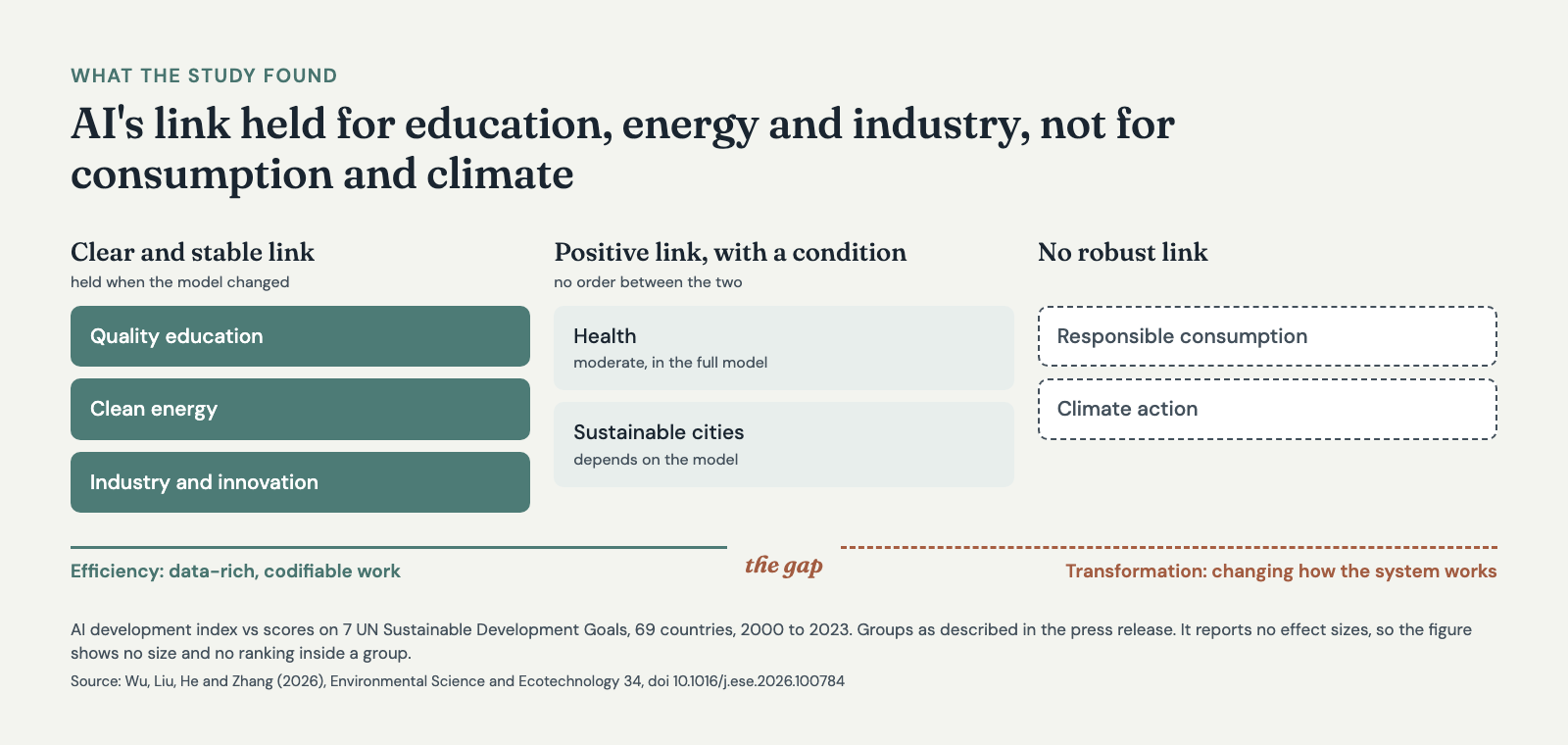
The paper was published online on 29 October 2026 in Environmental Science and Ecotechnology, by Meiling Wu and three co-authors. The team scored how far AI has spread in each country. The score combines six signals, among them patents, industrial robots and research staff. They then linked that score to each country's scores on seven UN Sustainable Development Goals. The data covers 69 countries from 2000 to 2023, and the method is a statistical technique called double machine learning.
The clearest links were with quality education, clean energy, and industry and innovation, and those links held when the authors changed the model. Health showed a moderate link in the full model, and sustainable cities a positive link that depended on the model. For responsible consumption and for climate action, the link was not robust. The Chinese Academy of Sciences issued a press release on the study. It reports that the authors see AI performing best where operations are data-rich and codifiable. The release adds that AI does not, by itself, change consumption patterns, regulatory ambition or the pace of decarbonization.
A second finding is about timing. Green innovation and government efficiency showed friction in the short term. The release reads this as a sign that early AI deployment can crowd out ecological innovation while it improves efficiency. It sums up the authors' view this way: AI is a conditional accelerator whose value depends on governance.
The limits matter here. This is a study of countries, not of companies. The release reports no effect sizes, so we do not quote any. We read the release and the journal record, and the full paper is open access at the address below.
The same gap inside a company
What follows is our reading, not the study's finding. The pattern the authors measured across countries has a version inside a company of 30 or 200 people.
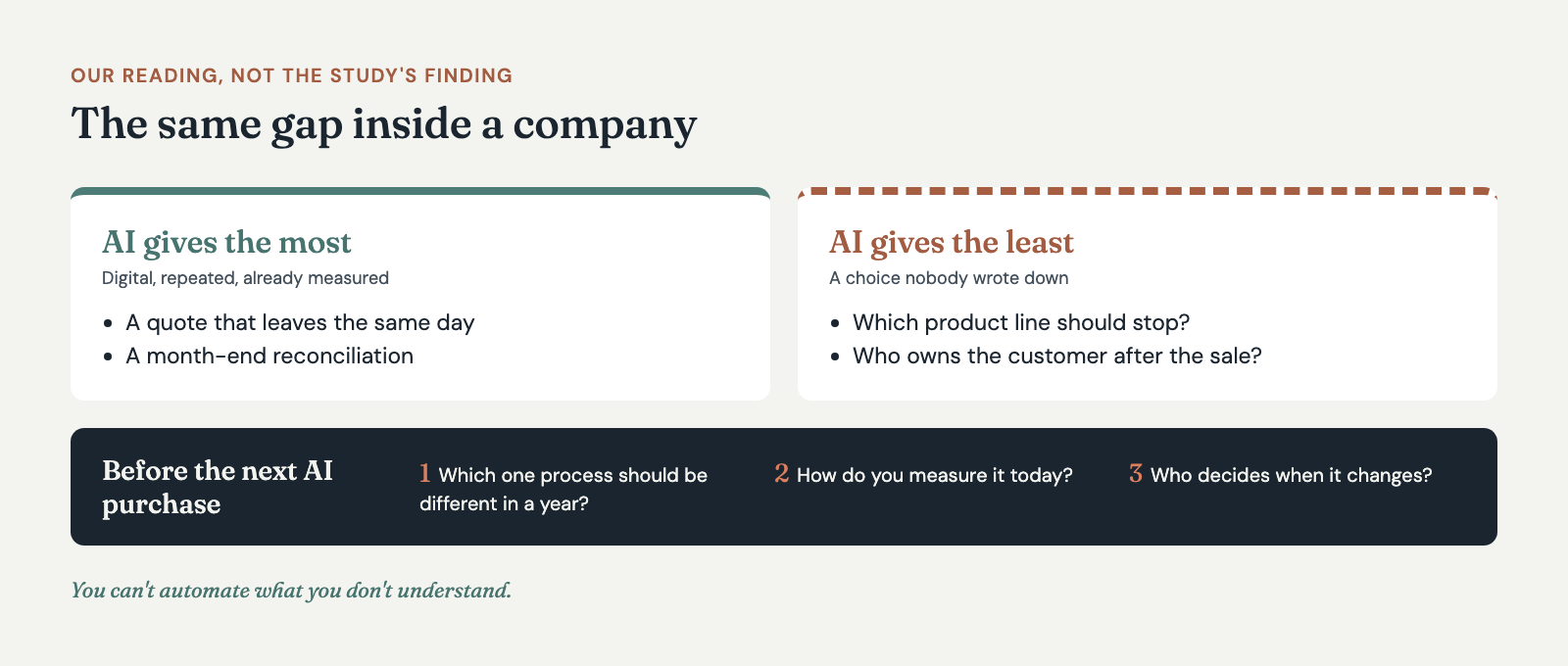
AI gives the most where the work is digital and repeated, and where someone already measures it. A quote or a month-end reconciliation is that kind of work. Its input is clear and its result is easy to check, so a tool can learn it and run it faster.
AI gives the least where the change is about what the company decides. Which product line should stop? Who should own the customer after the sale? No tool makes those calls, because each one depends on choices that nobody wrote down. A company can buy a lot of speed and still keep every one of those choices exactly where it was.
The timing finding is about green innovation, but we see a company version of it. A team that spends a year adding tools spends much of that year on adoption, with training, access and the exceptions nobody planned for. That effort is real. It can also push the harder question, how the work should be organized, to next year, and then to the year after.
In a company, the governance the authors talk about is concrete. It starts with a named person who owns a process and a clear rule for who decides when it changes. It also needs a number that says whether the change worked. Our view is the line we use for all of our work. You can't automate what you don't understand. Speed applied to a process nobody has drawn makes the same process faster, including the parts that should not exist.
Three questions before the next AI purchase
Here are the three questions we would ask before any AI purchase.
The first is which one process you want to be different a year from now, not only faster. If the answer is "all of them", the real answer is none of them yet.
The second is how you measure that process today. One number is enough, such as a cycle time or a cost per order. If no number exists, the first job is to get one, because without it nobody can tell an improvement from a feeling.
The third is who decides when that process changes. When the answer is "everybody" or "it depends", the tool will speed up the disagreement along with the work.
These questions come before any tool is chosen. A study of 69 countries is a long way from one company, and we say so. It still points in the direction we work from. The tool brings the speed. The change comes from the people who run the company.
The source
Meiling Wu, Wei Liu, Ziqiong He and Zhengyang Zhang. The global diffusion of artificial intelligence exposes an efficiency-transformation gap. Environmental Science and Ecotechnology, volume 34, November 2026.
Get the next field note by email. Subscribe to The Signal